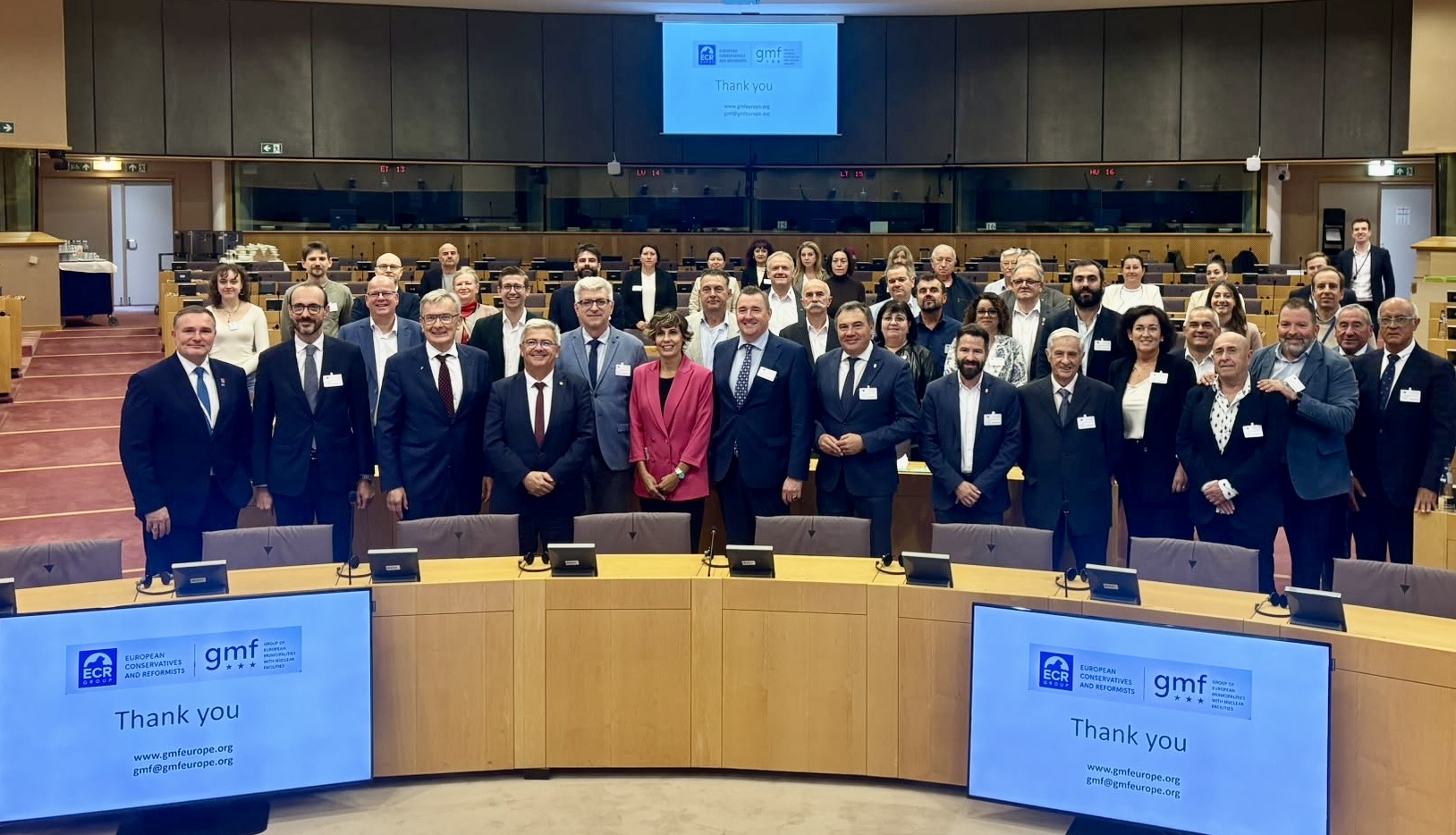
On 13 October 2026, GMF, in collaboration with the European Conservatives and Reformists (ECR) Group and hosted by Member of the European Parliament Mr. Kris Van Dijck, organised a roundtable discussion at the European Parliament. Approximately 50 participants attended the event, including MEPs, assistants to MEPs, mayors and local councillors from a range of European countries.
The event brought together Members of the European Parliament (MEPs) and mayors from nuclear host communities across Europe to engage in a dialogue on the role of local communities in shaping Europe’s nuclear future. The session gathered MEPs Mr. Bert-Jan Ruissen (Netherlands), Mr. Kris Van Dijck (Belgium), Ms. Rosa Estaràs (Spain) and Mr. Christophe Grudler (France), alongside the mayor of Borsele and president of GMF (Mr. Gerben Dijksterhuis), the mayor of Gravelines representing the French association of municipalities hosting nuclear installations ARCICEN (Mr. Bertrand Ringot), the representative of Hungarian association of nuclear settlements (Mr. Zoltán Bagó) and the president of the Spanish association of municipalities hosting nuclear facilities, AMAC (Mr. Pedro Sánchez) and Mr. Andrea Borio di Tigliole of the International Atomic Energy Agency (IAEA). The IAEA underscored the strategic importance of local communities in nuclear areas and its commitment to the Global Partnership of Nuclear Communities — founded in 2023 by GMF, the Energy Communities Alliance (USA) and the Canadian Association of Nuclear Host Communities (CANHC).
The session delivered a clear message: local communities that host nuclear facilities must be strategic partners in decision-making related to nuclear matters. Nuclear host communities deserve the right to have a voice and real influence at every stage of a nuclear project – from siting and operation to shut down and decommissioning – and across all technologies, including large reactors, Small Modular Reactors (SMRs), advanced reactors, geological repositories, etc. They need formal recognition in European legal, institutional and political frameworks, and the appropriate opportunities to access information, technical expertise and participation funding to strengthen their engagement as equal partners in decision-making processes. A call to action is being prepared and will be released in the next days.